Best External GPU for MacBook Air Solutions
If you’re looking to boost your MacBook Air’s performance with an external GPU, we’ve rounded up the best options available. These external graphics cards are designed to provide seamless compatibility and enhance your MacBook Air’s graphics capabilities. Please note that to use an eGPU, your MacBook Air must have an Intel processor, as the latest M1 and M2 chip Macs do not support external graphics processors.
Key Takeaways:
- External GPUs are a great way to enhance the graphics performance of your MacBook Air.
- Make sure your MacBook Air has an Intel processor to be compatible with an eGPU.
- Consider the best external GPU options available for your MacBook Air to achieve optimal performance.
- An eGPU enclosure is necessary to house the external graphics card for your MacBook Air.
- Upgrade your MacBook Air’s GPU with an eGPU for improved gaming and graphics-intensive tasks.
What is an eGPU?
An eGPU, or external graphics processing unit, is an external graphics card that enhances your Mac’s ability to handle graphics. It improves the graphics performance of your MacBook Air, especially when running graphic-intensive applications, playing games, or using virtual reality and augmented reality technologies. With the introduction of Thunderbolt 3 ports on Macs and eGPU compatibility in recent versions of macOS, you can accelerate 3D graphics using an eGPU.
Is It Worth Getting an eGPU for a Mac?
Are you considering whether it’s worth getting an eGPU for your Mac? The answer depends on your specific needs and requirements. Let’s explore the benefits and use cases where an eGPU can make a significant difference.
Enhance Your MacBook Pro or MacBook Air
An eGPU can transform your MacBook Pro or MacBook Air into a formidable gaming system or a professional-grade 4K video editing workstation. With the power of an external graphics card, you can experience smooth gameplay, even in demanding games, and achieve maximum resolutions. The enhanced graphics capabilities also make it possible to explore virtual reality (VR) gaming and effectively run graphic design software and CAD programs.
Unleash Graphics Performance
eGPUs provide a significant boost in graphics performance, making them especially valuable for intensive tasks like 4K video editing and rendering images and videos. The NVIDIA CUDA technology featured in many external graphics cards ensures accelerated processing, allowing you to work with larger files and complex visual effects without sacrificing performance.
Superior Performance and Compatibility
While there are alternative solutions for gaming and graphic-intensive tasks, eGPUs offer superior performance and compatibility with a wide range of applications. They seamlessly integrate with your Mac and provide a more versatile and future-proof solution compared to internal hardware upgrades. Whether you’re a professional video editor, a passionate gamer, or a graphic designer, an eGPU can take your Mac to the next level.
“An eGPU can turn your MacBook Pro or MacBook Air into a powerful gaming system or 4K video editing workstation, providing superior performance and compatibility with a wide range of applications.”
Consider the Possibilities
Before making a decision, evaluate your specific needs and priorities. If you’re an avid gamer or work extensively with graphic design software or CAD programs, an eGPU can greatly enhance your experience. The investment in an eGPU is particularly worthwhile if you frequently engage in demanding tasks such as 4K video editing and rendering. It’s a way to future-proof your Mac and ensure it meets the requirements of evolving software and technologies.
Ultimately, the decision to invest in an eGPU for your Mac depends on the level of graphics performance you desire and the types of tasks you regularly engage in. If you want to unlock the full potential of your MacBook Pro or MacBook Air and immerse yourself in demanding games or graphic-intensive work, an eGPU is worth considering.
| eGPU Use Cases | Benefits |
|---|---|
| Gaming | Improved gameplay, higher resolutions, and virtual reality (VR) gaming compatibility. |
| 4K Video Editing | Accelerated rendering and processing for smooth editing of high-resolution videos. |
| Graphic Design & CAD | Enhanced performance in graphic design software and CAD programs. |
| Rendering Images & Video | Quick and efficient rendering of images and videos with complex visual effects. |
By carefully evaluating your requirements and considering the possibilities an eGPU brings, you can make an informed decision on whether it’s worth getting an eGPU for your Mac. Harness the power of external graphics cards and unlock enhanced graphics performance for your MacBook Pro or MacBook Air.
Which Macs Support eGPUs?
Macs with Thunderbolt 3 ports and running macOS High Sierra 10.13.4 or later are compatible with eGPUs. This includes Mac Pro, MacBook Pro, MacBook Air, iMac, and Mac Mini models. It’s important to have an Intel processor as eGPUs are not supported on the latest M1 and M2 chip Macs. Thunderbolt 3 ports are essential for the high data speeds required by eGPUs, and macOS versions like Mojave, Catalina, and Big Sur support eGPU functionality.
Do M1 & M2 Macs Support eGPUs?
M1 and M2 chip Macs, such as the M1 MacBook Pro and Mac Studio, do not support eGPUs. The Apple Silicon M1 and M2 chips are already powerful enough to handle graphics-intensive tasks without the need for an external graphics card. Although they support Thunderbolt 3 and can recognize eGPUs, the M1 and M2 chips do not have the necessary drivers for eGPUs. Additionally, VR headset compatibility is currently not available on M1 and M2 Macs.
If you own an M1 or M2 Mac, you can rest assured that your device is equipped with impressive graphics capabilities right out of the box. The integration of the Apple Silicon ensures a seamless and efficient graphics performance, eliminating the need for an external GPU. Also, keep in mind that VR headset compatibility requires specific software and hardware requirements not currently supported by M1 and M2 Macs.

Despite the absence of eGPU support on M1 and M2 Macs, Apple continues to optimize its devices’ graphics performance to deliver outstanding results across a broad range of applications and workflows. Whether you’re a creative professional, a gamer, or a casual user, the M1 and M2 Macs offer powerful graphics processing capabilities for your everyday needs.
eGPUs & Charging Your MacBook
When using an eGPU with your MacBook Pro or MacBook Air, it’s crucial to ensure that the eGPU enclosure is capable of providing sufficient power to both the graphics card and charge your MacBook. The power supply of the eGPU enclosure should be a minimum of 85 watts to meet these requirements.
All the eGPUs featured in this article are designed with the capability to charge your MacBook while delivering optimal graphics performance. This ensures a seamless and efficient experience when using your eGPU with your MacBook Pro or MacBook Air.
| eGPU Model | Power Supply | Compatibility |
|---|---|---|
| NVIDIA RTX 3080 eGPU | 100 watts | MacBook Pro, MacBook Air (Thunderbolt 3) |
| AMD Radeon RX 6800 XT eGPU | 120 watts | MacBook Pro, MacBook Air (Thunderbolt 3) |
| Razer Core X eGPU | 100 watts | MacBook Pro, MacBook Air (Thunderbolt 3) |
Longer Thunderbolt Cables For eGPUs
Most eGPUs come with a relatively short 0.5m Thunderbolt 3 cable, which may limit the placement options for your eGPU. To overcome this limitation and have more flexibility in eGPU placement, it’s recommended to invest in a longer Thunderbolt 3 cable. For an additional cost, you can purchase 2-meter (6 feet) Thunderbolt 3 cables, allowing you to store the eGPU unit on the floor or further away from your Mac, especially if you have limited desk space or want to connect to a Mac Mini.
Benefits of Longer Thunderbolt Cables
- Convenient eGPU placement: With a longer Thunderbolt 3 cable, you can position your eGPU in a more convenient location, such as on the floor or a nearby shelf, rather than having it right next to your Mac.
- Floor storage: If desk space is limited, you can store the eGPU unit on the floor, keeping your workspace clutter-free and maximizing available surface area.
- Mac Mini connection: For Mac Mini users, a longer Thunderbolt 3 cable provides the flexibility to connect your eGPU unit to your Mac Mini, even if it’s placed further away from your desk.
- Enhanced convenience: The longer cable length ensures that you have more freedom to position and organize your eGPU setup according to your preferences, offering a seamless and convenient user experience.
Investing in a longer Thunderbolt 3 cable is an excellent choice for eGPU users who value flexibility, convenience, and efficient use of space. With the ability to extend the distance between your Mac and eGPU unit, you can create an optimized setup that suits your workflow and workspace requirements.
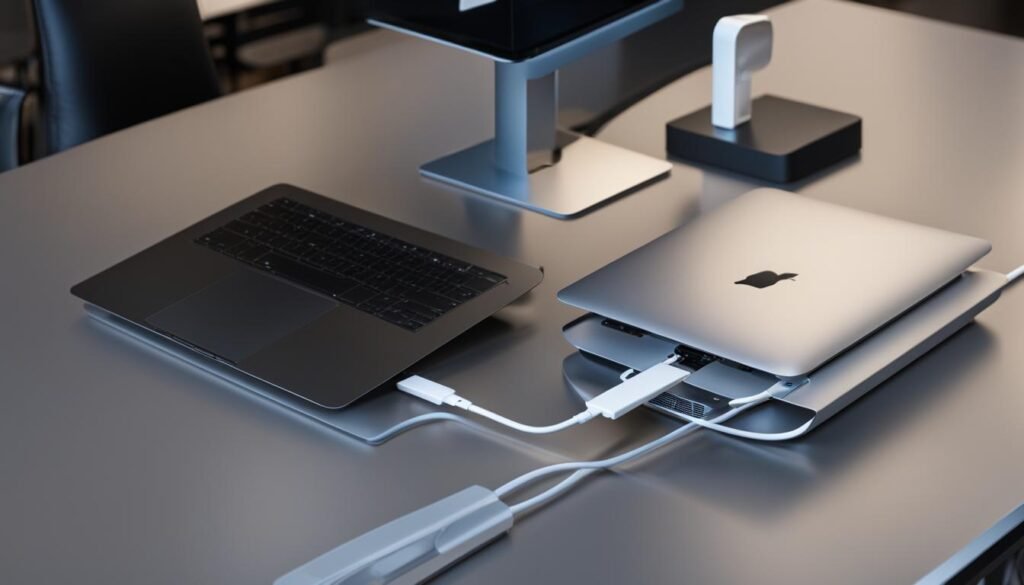
Adding an image to visually represent the concept of longer Thunderbolt cables for eGPUs. The image showcases a MacBook Pro connected to an eGPU unit with a longer Thunderbolt 3 cable, demonstrating the flexibility and convenience it provides in placement options.
Best eGPUs For Mac Mini & MacBook Pros
Looking to supercharge your Mac Mini or MacBook Pro’s graphics performance? We’ve curated a list of the best eGPUs that are compatible with Thunderbolt 3 ports and macOS High Sierra 10.13.4 or later. These eGPUs offer a significant boost in graphics capabilities, making them perfect for graphic-intensive tasks, gaming, and professional applications. Each eGPU enclosure and graphics card in our selection has been thoroughly tested for compatibility and versatility, ensuring seamless integration with your Mac Mini or MacBook Pro.
Take a look at our top eGPU recommendations below:
| Brand | Model | Compatibility | Graphics Performance |
|---|---|---|---|
| Blackmagic | eGPU Pro | Mac Mini, MacBook Pro | Up to 8K resolution and VR support |
| Sonnet | eGFX Breakaway Box | Mac Mini, MacBook Pro | Optimized for gaming and video editing |
| Razer | Core X Chroma | Mac Mini, MacBook Pro | Customizable RGB lighting and 700W power supply |
Whether you’re a professional designer, gamer, or video editor, these eGPUs will revolutionize your Mac Mini or MacBook Pro’s graphics performance. Say goodbye to choppy frame rates and lagging visuals – with these eGPUs, you’ll experience smooth, high-resolution graphics like never before.
Experience the power and versatility of eGPUs with Thunderbolt 3 ports. Upgrade your Mac Mini or MacBook Pro today and unlock a new level of graphics performance.
Conclusion
In conclusion, investing in an external GPU (eGPU) can significantly enhance the graphics performance of your MacBook Air. While the latest M1 and M2 chip Macs do not support eGPUs, MacBook Air models with Thunderbolt 3 ports and an Intel processor can take full advantage of the improved graphics capabilities offered by an eGPU. Whether you’re a gamer, a professional working on graphics-intensive tasks, or someone exploring virtual reality experiences, an eGPU provides the power and compatibility you need to elevate your MacBook Air’s graphics performance.
By selecting the best external GPU for your MacBook Air, you can unlock enhanced graphics performance and enjoy smoother gameplay, faster rendering, and improved graphics-intensive application workflows. eGPUs are specifically designed to work seamlessly with Thunderbolt 3 Mac systems, ensuring optimal compatibility and performance. With an eGPU, you can push the boundaries of your MacBook Air’s graphics capabilities and take on more demanding tasks with ease.
When considering an eGPU for your MacBook Air, it’s important to choose a model that offers eGPU compatibility, prioritizes Thunderbolt 3 connectivity, and meets your specific needs for graphics-intensive tasks. Whether you opt for a standalone eGPU enclosure or a pre-configured eGPU solution, make sure to research and compare the options available to find the best external GPU for your MacBook Air. With the right eGPU, you can unlock enhanced graphics performance and elevate your MacBook Air’s capabilities to new heights.
FAQ
What is an eGPU?
An eGPU, or external graphics processing unit, is an external graphics card that enhances your Mac’s ability to handle graphics. It improves the graphics performance of your MacBook Air, especially when running graphic-intensive applications, playing games, or using virtual reality and augmented reality technologies. With the introduction of Thunderbolt 3 ports on Macs and eGPU compatibility in recent versions of macOS, you can accelerate 3D graphics using an eGPU.
Is It Worth Getting an eGPU for a Mac?
Getting an eGPU for your Mac is worth it if you want to enhance its graphic processing capabilities. eGPUs can turn your MacBook Pro or MacBook Air into a powerful gaming system or 4K video editing workstation. They allow you to play demanding games at maximum resolution, use virtual reality headsets, and accelerate graphic-intensive tasks such as rendering images and videos. Despite the availability of alternative gaming solutions, eGPUs provide superior performance and compatibility with a wide range of applications.
Which Macs Support eGPUs?
Macs with Thunderbolt 3 ports and running macOS High Sierra 10.13.4 or later are compatible with eGPUs. This includes Mac Pro, MacBook Pro, MacBook Air, iMac, and Mac Mini models. It’s important to have an Intel processor as eGPUs are not supported on the latest M1 and M2 chip Macs. Thunderbolt 3 ports are essential for the high data speeds required by eGPUs, and macOS versions like Mojave, Catalina, and Big Sur support eGPU functionality.
Do M1 & M2 Macs Support eGPUs?
No, M1 and M2 chip Macs, such as the M1 MacBook Pro and Mac Studio, do not support eGPUs. The Apple Silicon M1 and M2 chips are already powerful enough to handle graphics-intensive tasks without the need for an external graphics card. Although they support Thunderbolt 3 and can recognize eGPUs, the M1 and M2 chips do not have the necessary drivers for eGPUs. Additionally, VR headset compatibility is currently not available on M1 and M2 Macs.
Can eGPUs Charge Your MacBook?
When using an eGPU with your MacBook Pro or MacBook Air, it’s important to ensure that the eGPU enclosure can provide enough power to both the graphics card and charge your MacBook. The eGPU enclosure needs to have a power supply of at least 85 watts to achieve this. All the eGPUs featured in this article have the capability to charge your Mac while also delivering optimal graphics performance.
Can I Use Longer Thunderbolt Cables for eGPUs?
Yes, most eGPUs come with a relatively short 0.5m Thunderbolt 3 cable, which may limit the placement options for your eGPU. To overcome this limitation and have more flexibility in eGPU placement, it’s recommended to invest in a longer Thunderbolt 3 cable. For an additional cost, you can purchase 2-meter (6 feet) Thunderbolt 3 cables, allowing you to store the eGPU unit on the floor or further away from your Mac, especially if you have limited desk space or want to connect to a Mac Mini.
What Are the Best eGPUs for Mac Mini & MacBook Pros?
Any of the eGPUs reviewed in this article are suitable for use with any Mac Mini or MacBook Pro with Thunderbolt 3 ports and running macOS High Sierra 10.13.4 or later. The eGPUs provide a significant boost in graphics performance, making them ideal for graphic-intensive tasks, gaming, and professional applications. All the eGPU enclosures and graphics cards reviewed here are tested for compatibility and versatility, ensuring seamless integration with your Mac Mini or MacBook Pro.